


Our friend Adam is 45 years old, in good physical shape, and has no health problems. His primary activity is cycling – about 150 minutes a week at a moderate pace. At 185 cm tall, he weighed 87 kg, which is considered overweight, so Adam decided to lose weight. During a visit to a dietitian, he learned that reducing his calorie intake would be crucial. Reducing his daily intake by 400 kcal should result in an average weight loss of about 0.5 kg per week.
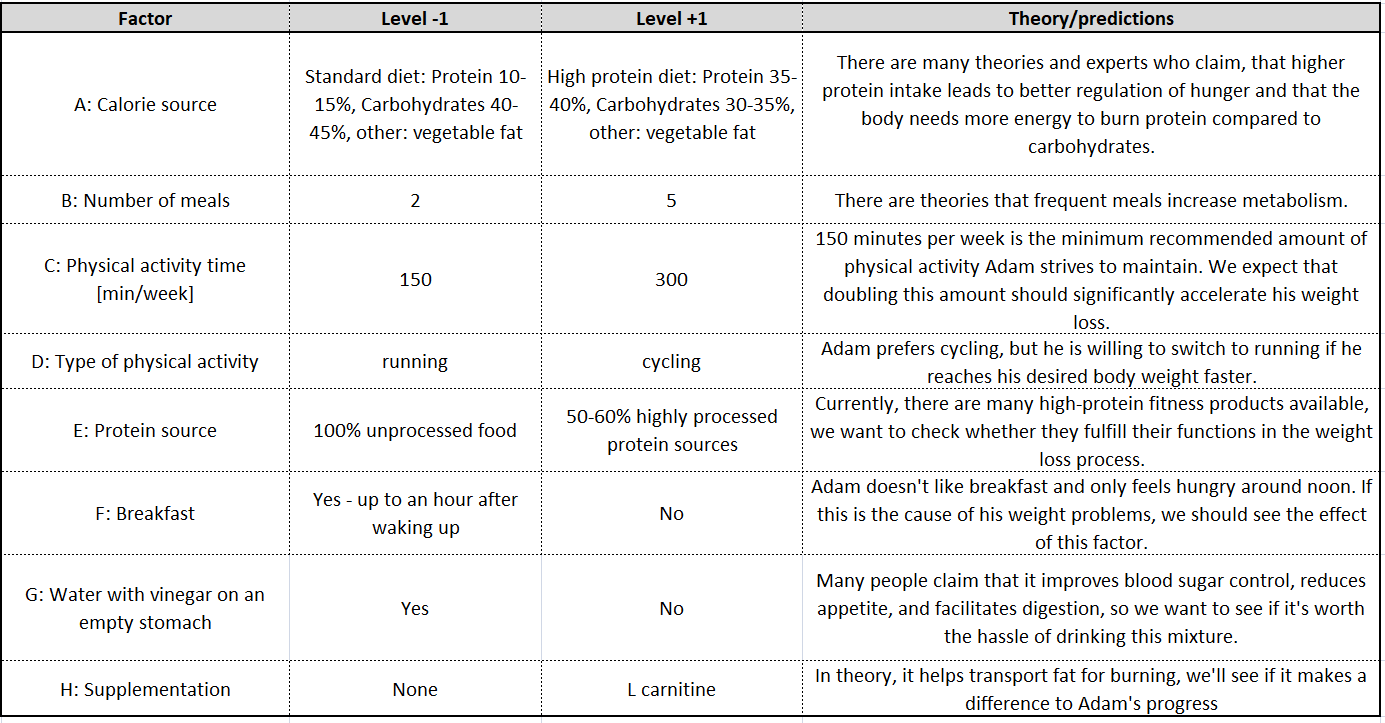
The aim of the experiment was to test whether additional factors often considered to aid weight loss could actually accelerate Adam’s weight loss. The factors to be tested are presented in the prediction table below.
Click on image to enlarge it
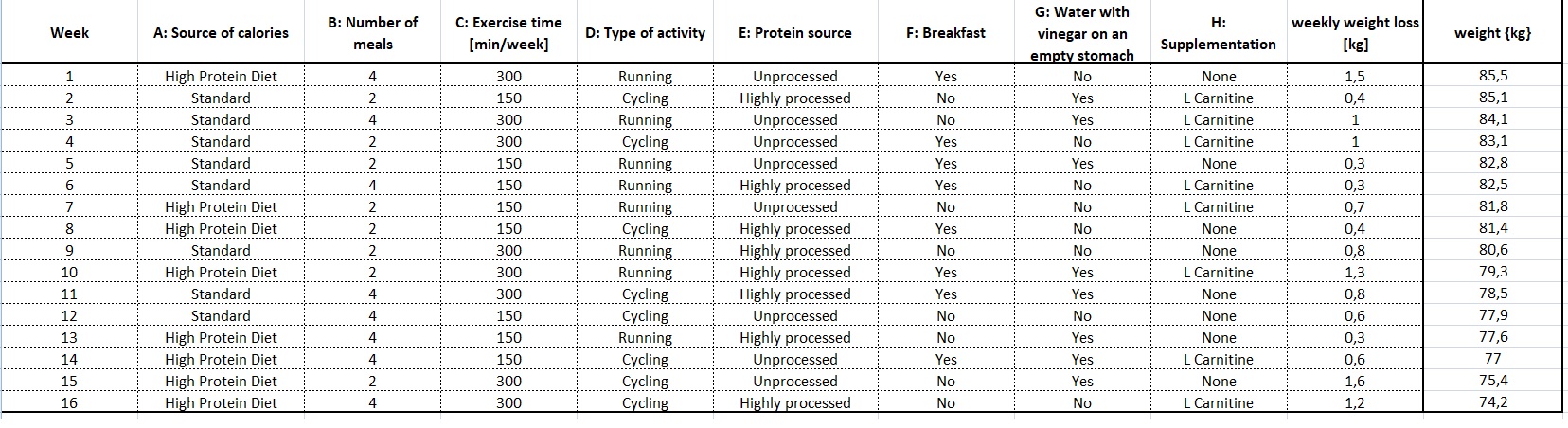
To test eight factors at two levels, we used a fractional experiment (2IV^8-4=16 runs). The entire experiment lasted 16 weeks – each week was one run.
Adam always weighed himself on Monday mornings, and the main outcome measured during this DOE was weight loss in kilograms compared to the previous week. Throughout the entire experiment, Adam maintained a calorie deficit (–400 kcal per day) and drank approximately 3 liters of water each day. A detailed experimental design is presented in the DOE matrix below.
Click on image to enlarge it
EXPERIMENT ANALYSIS
We will begin the analysis with a practical look at the data.

During the experiment, Adam lost between 0.3 and 1.6 kg (1.7 to 3.3 lbs) per week. The projected weight loss, thanks to maintaining a calorie deficit, was approximately 0.5 kg (1.1 lbs) per week. The significant variation in the results, sometimes significantly exceeding the predicted weight loss, indicates that the tested factors influenced the rate of weight loss.
There is no apparent relationship between the passage of time and Adam’s weight loss – weeks with large and small weight loss occurred randomly. This indicates that the variation in this DOE was caused by the tested factors and not by anything that changed over the 16 weeks of the experiment.

Plotting the DOE results sorted from minimum to maximum, we observe a steady decline in Adam’s weight. The lack of points with significant positive or negative deviations indicates that the variation in this experiment was created by the factors tested at the given levels – no special cause variation occurred during the DOE.

Adam, who weighed 87 kg before the experiment, reached 74.6 kg after 16 weeks. This weight loss was achieved both by reducing his calorie intake and by using some of the factors tested in this DOE.
This concludes today’s OpEx story. In the next part, we’ll learn how other factors influenced Adam’s weight loss journey.
Have questions, thoughts, or something that particularly piques your interest? Join the discussion below on our LinkedIn post. Follow us to stay up to date.